

5 Leadership Lessons for Tradies from Vocational Training Specialist Raman Badekar

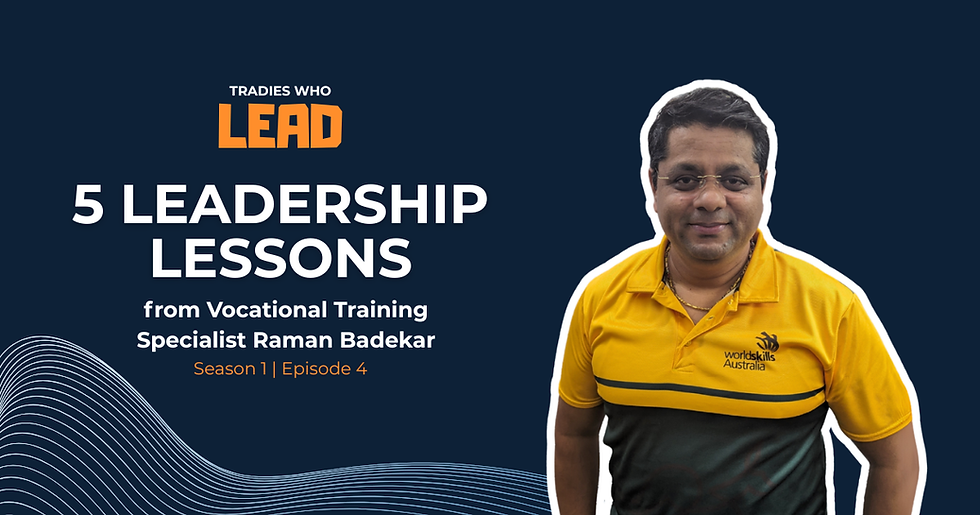
Guest: Raman Badekar
Episode: Season 1, Episode 4
Listen here
Raman Badekar started as a maintenance mechanic apprentice and went on to mentor World Skills medallists and lead skilling projects across Australia, New Zealand, India and China.
Here’s what he had to say about leading yourself and others.
Lesson 1: Reliability as a Mentor in the Trades
Raman traces his leadership instincts back to his time as a patrol leader in the Boy Scouts, where the job wasn’t just about building a tent the fastest, but about keeping a team motivated toward a shared goal while making room to celebrate wins along the way.
Those early lessons taught him that showing up looks different depending on what’s needed, and have carried through his whole career.
"Showing up to me is the belief that the people you are leading (even your friends) have that you will show up when needed," Raman says.
That could mean being physically present, taking a phone call, or simply liking a mentee's LinkedIn post to help their reach go further.
Lesson 2: Why Mentoring Apprentices Matters
Raman grew up in a small country town in India and credits the mentors who guided him early on with everything that followed, including his move to Australia and his career since then.
"It will be rather selfish not to give it to others," Raman says of the debt he feels toward paying that forward.
What struck him most wasn't that people gave advice, but that they gave it before he ever asked.
"Somebody saw that potential in me; they didn't wait for me to approach them," he says, and it's a model he's tried to replicate for the apprentices and mentees who've come through his own career since.
Lesson 3: Building Trust with Apprentices
Raman has mentored across very different eras of the trades, from the stricter, more direct style he experienced as an apprentice to the more consultative approach expected today. He says the one constant underneath both is trust.
"Very critical that you work towards building trust very early on, and for that you have to have really good communication skills," Raman says.
In practice, that means adapting to how the other person communicates, whether that's navigating a language barrier or reading how formal the relationship should be. He also makes a point of letting the relationship run both ways, which he says blurs the hierarchy just enough for people to feel comfortable actually asking for help.
Lesson 4: People Skills vs. Technical Skills in a Trade Career
Raman argues that the people skills picked up during a trade apprenticeship often matter more over a lifetime than the technical skills themselves. He points to his own career as proof: strategising, setting goals, and writing are all skills he can trace directly back to lessons learned during his three years as an apprentice.
"I don't think I've ever met a tradie who knew everything when they qualified," Raman says, pushing back on the idea that qualification is the finish line rather than the start.
What he calls "the transferability of great skills" is, in his view, the real inheritance of a trade career and part of the knowledge we need to pass on to the next generation.
Lesson 5: How to Mentor an Apprentice Effectively
For anyone mentoring an apprentice without formal training in teaching, Raman’s advice starts with reflecting on how you yourself learned best, then building from there. This may include:
Showing and telling
Breaking things into small steps
Using analogies for anything conceptual
But the piece Raman stresses most is humility.
"Get off the pedestal very quickly, because the new generation is very well informed," he says. “The student is your metric of success, not your perception of your teaching skill."
Raman encourages mentors to openly ask their apprentices for feedback on their own teaching, arguing that it builds more trust than pretending to have all the answers.
Raman’s Advice on Everyday Leadership
"Question yourself why you are doing what you're doing, and if you don't find an answer to that, don't do it. But if you know why you're doing it, then commit to it fully."
Because that commitment, he says, is what actually takes you where you want to go, whether that's a stable income, family time, or the freedom to travel.
Catch the full conversation with Raman Badekar on Tradies Who Lead for more leadership lessons for tradies, out now wherever you listen to podcasts.


Comments